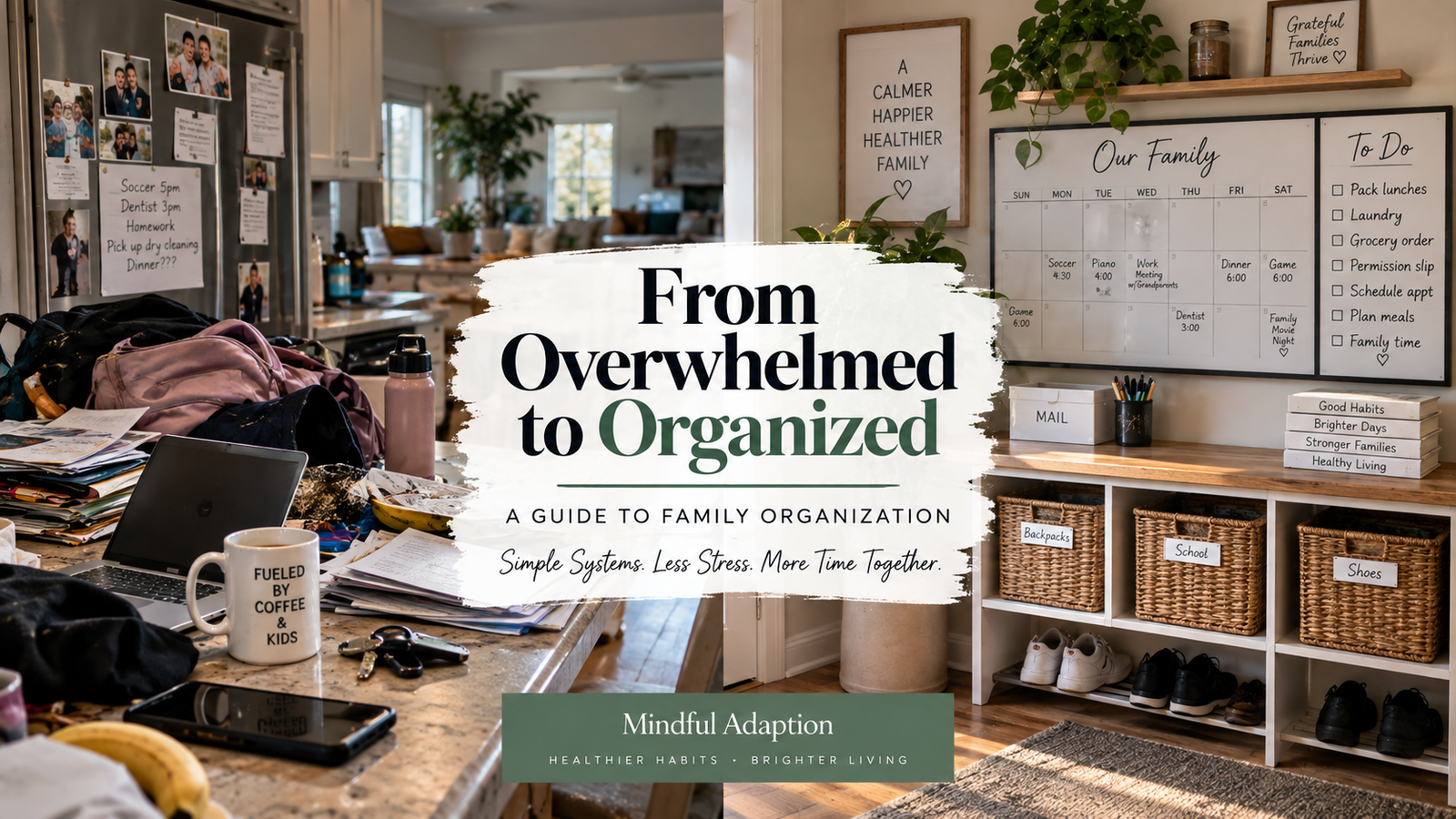
From Overwhelmed to Organized: A Guide to Family Organization
For working parents, getting organized isn’t about creating a picture-perfect home. It’s about building simple systems that make everyday family life easier.
There’s a particular kind of chaos that can happen around 7:30 on a weekday morning.
One child can’t find their shoes. Someone forgot that today is picture day. Lunches still need to be packed. Your phone is reminding you about a meeting in 30 minutes. There’s a permission slip sitting somewhere in the house, and you’re fairly certain the laundry you need is still in the dryer.
Then someone asks:
“What are we having for dinner?”
It can feel like you’ve already worked an entire day before your actual workday has even started.
For working parents, family organization isn’t simply about keeping a tidy house. You’re coordinating people, schedules, meals, school responsibilities, appointments, work commitments, household tasks, and dozens of tiny details that are easy to forget.
The solution isn’t remembering more.
It’s creating a family system that requires you to remember less.
Here’s how to build one without turning organization into another exhausting project.
Family organization should reduce the number of decisions you have to make during already-busy moments.
Stop Trying to Keep the Household in Your Head
One of the biggest sources of family stress is invisible.
It’s the mental list.
You remember that the toothpaste is almost empty.
You know your child needs $10 for something at school on Thursday.
You’re thinking about the dentist appointment next month.
You noticed there are only two clean towels left.
You need groceries.
The dog needs food.
There’s a birthday party Saturday.
And while you’re making dinner, you’re trying to remember whether tomorrow is the day one of the kids needs to bring something special to school.
That’s a lot of information to carry around.
The first goal of family organization should therefore be simple:
Get information out of your head and into a trusted system.
It doesn’t matter whether your family prefers a physical calendar, digital calendar, whiteboard, planner, or combination.
What matters is that important information has one predictable home.
If an appointment gets scheduled, it goes there.
If school sends home an important date, it goes there.
If someone makes weekend plans, they go there.
Your brain shouldn’t have to function as the household’s notification system.
Create a Family Command Center
“Command center” sounds elaborate.
It doesn’t need to be.
Choose one frequently used area of your home—perhaps near the kitchen, entryway, or mudroom—and give important everyday items designated places.
Your command center might contain:
- A family calendar
- Incoming school papers
- Outgoing forms
- Keys
- A grocery list
- Backpacks
- A weekly meal plan
- Charging cables
- A small basket for miscellaneous items
The purpose isn’t decoration.
It’s predictability.
Instead of:
“Where did you put the permission slip?”
the answer becomes:
“Check the school-paper basket.”
Instead of:
“Where are my keys?”
they go on the same hook every day.
Tiny systems like these can eliminate surprisingly large amounts of frustration.
Give Things a “Home”
Look around your house for items that regularly cause problems.
Shoes.
Chargers.
Backpacks.
Mail.
Sports equipment.
Reusable water bottles.
Homework.
Keys.
If your family is constantly searching for the same thing, that’s useful information.
The problem may not be that everyone is disorganized.
The item may simply not have an obvious home.
For example, put a basket beside the door specifically for children’s shoes.
Give each child a backpack hook.
Create one charging station instead of having cables scattered throughout the house.
Put a laundry basket where clothes are actually being removed—not necessarily where you think the laundry basket should look best.
Organization becomes easier when your systems match how your family actually behaves.
Give frequently used family items a predictable place to return to.
Build Around Your Most Chaotic Times
Don’t organize your entire house at once.
Instead, identify the part of the day that causes the most friction.
For many working families, it’s one of three periods:
Morning.
After school.
Bedtime.
Start there.
If mornings are difficult:
Prepare backpacks at night.
Choose clothes before bed.
Keep breakfast simple on weekdays.
Put shoes near the exit.
Fill water bottles ahead of time.
If evenings are difficult:
Create a homework station.
Have a predictable dinner window.
Use a short after-dinner cleanup routine.
Check tomorrow’s calendar before bedtime.
If bedtime is difficult:
Use the same sequence each evening.
For example:
Bath → pajamas → teeth → backpack check → story → bed.
Children don’t necessarily need an elaborate schedule.
Often, knowing what happens next is enough to make transitions easier.
Stop Making Dinner a Daily Emergency
It’s 5:42 PM.
Everyone is hungry.
You’re tired.
And you’re standing in front of the refrigerator hoping ingredients somehow assemble themselves.
Dinner becomes stressful when the decision is repeatedly postponed until the moment everyone needs the answer.
You don’t need an elaborate meal-prepping system to improve this.
Try planning just five dinners.
For example:
Monday: Pasta and salad
Tuesday: Tacos
Wednesday: Chicken, rice, and vegetables
Thursday: Leftovers
Friday: Homemade pizza night
That’s enough.
You can also create a list called:
“Meals Everyone Will Actually Eat”
Keep 10–15 reliable meals there.
When you’re planning the week, choose from that list instead of inventing a new menu every Sunday.
Less decision-making is often more valuable than more variety.
Create a 10-Minute Evening Reset
You don’t need to restore your entire house every night.
Try resetting the areas tomorrow morning depends on.
Set a timer for ten minutes.
Everyone who is old enough gets a job.
One person loads dishes.
Someone clears the living room.
Someone gathers shoes.
Backpacks get checked.
Counters get cleared.
Coffee gets prepared.
Lunch items get grouped together.
Then stop when the timer ends.
The objective isn’t:
“The house must be spotless.”
It’s:
“Tomorrow morning should be easier because of what we did tonight.”
That’s a very different goal.
Ten minutes tonight can remove several points of friction tomorrow morning.
Make Responsibilities Visible
One reason parents become overwhelmed is that household work can become concentrated around one person.
Instead of repeatedly asking:
“Can somebody help me?”
assign recurring responsibilities.
A child might be responsible for:
Feeding the pet.
Another:
Putting napkins on the dinner table.
Another:
Bringing dirty clothes to the laundry area.
Adults can divide recurring responsibilities too.
The important distinction is between helping and owning.
If someone owns a task, another family member shouldn’t need to constantly notice, delegate, and supervise it.
Responsibilities should, of course, match each person’s age and ability.
But even small responsibilities teach an important idea:
Our household works because everyone contributes.
Use a Weekly Family Reset
Choose one predictable time each week for a 15–20 minute planning session.
Sunday afternoon may work.
Maybe Saturday morning works better.
Bring up the family calendar and ask:
What’s happening this week?
Check:
School events.
Work commitments.
Appointments.
Activities.
Transportation.
Meals.
Bills.
Special clothing or supplies.
Weekend plans.
Anything unusual.
Then ask one extremely useful question:
“What could make this week difficult?”
Maybe Wednesday has three activities.
Maybe someone will be working late Thursday.
Maybe the refrigerator is almost empty.
Maybe a school project is due Friday.
Seeing those problems ahead of time allows you to prepare instead of react.
Create Systems Children Can Actually Follow
An organization system isn’t successful because it looks beautiful on social media.
It’s successful because your family uses it.
If young children can’t reach the backpack hooks, the hooks are too high.
If the laundry system requires six different categories nobody follows, simplify it.
If nobody remembers to check the beautifully designed planner tucked inside a drawer, put the calendar somewhere visible.
Good organization reduces resistance.
Ask:
Can everyone understand this?
Can everyone reach it?
Can we maintain it when we’re tired?
That last question matters.
Any system can work when you’re motivated.
The best systems still work on Thursday night when everyone has had enough.
Leave Space for Real Life
A family organization system shouldn’t collapse because somebody got sick.
Or because you ordered pizza instead of cooking.
Or because laundry sat unfolded for two days.
Organization is supposed to support your family—not become another standard your family constantly fails to meet.
Leave margin.
Have backup meals.
Keep a little unscheduled time.
Allow baskets to temporarily contain things.
Have a place for paperwork you haven’t dealt with yet.
Your home is being lived in.
It will sometimes look like it.
That’s normal.
Don’t Organize What You Can Eliminate
Sometimes the easiest way to organize something is to have less of it.
If the entryway constantly overflows with shoes, ask how many pairs actually need to stay there.
If children’s artwork covers every surface, choose a display area and a memory box.
If you’re organizing hundreds of toys nobody plays with, consider donating some.
If your schedule is impossible to manage, the answer may not be a better calendar.
You may need fewer commitments.
Before buying another organizer, ask:
Do we need a better place for this—or do we simply have too much?
That’s a powerful distinction.
The best family organization system is the one your household can realistically maintain.
Your Family Organization Action Checklist
Don’t try to implement everything in this article today.
Start with this:
- Identify the most stressful part of your family’s day.
- Choose one central place for the family schedule.
- Give three commonly lost items permanent homes.
- Plan five dinners for the coming week.
- Introduce a 10-minute evening reset.
- Give each capable family member one recurring responsibility.
- Schedule a 15-minute weekly planning session.
- Simplify one system that’s currently too complicated.
- Remove something your family no longer needs.
- Ask: “What would make tomorrow easier?”
That final question can become the foundation of your entire system.
You Don’t Need an Organized Life—You Need an Easier One
It’s easy to imagine that organized families have spotless homes, perfectly labeled containers, coordinated calendars, and children who happily put everything away.
Real family life rarely looks like that.
Organization isn’t the absence of mess.
It’s knowing where the backpack belongs when someone is running late.
It’s realizing tonight that tomorrow is picture day instead of discovering it five minutes before school.
It’s having three dependable dinner options when you’re exhausted.
It’s everyone knowing what they’re responsible for.
It’s being able to look at your week and understand what’s coming.
Most importantly, it’s creating enough structure that your family has more room for living and less time spent managing preventable chaos.
So don’t reorganize your entire house this weekend.
Choose the part of family life that’s frustrating you most.
Then create one small system that makes it easier.
Use it for a week.
Adjust it.
And when it begins working without requiring much thought, move on to the next thing.
That’s how an overwhelmed household gradually becomes an organized one—not through one enormous transformation, but through small systems that quietly make everyday life work better.